







































 Advertisement
 Advertisement






















By Candace McDuffie, The Root —
The legacy of slavery still has modern-day repercussions for Black Americans. It lasted four centuries and was the worst crime against humanity this country has ever committed. America’s economy thrived off of this cruel practice for an extensive period of time by kidnapping millions of Africans. Here are 21 truths and myths about the transatlantic slave trade.
Myth: Africans Were Unskilled Laborers
Slave labor has often been portrayed as unskilled work, in an attempt to justify the brutal torture and dehumanization that Africans were subjected to. In reality, cultivating sugar, cotton, tobacco and other crops required meticulous and strenuous efforts. Slaves were highly skilled tailors, carpenters, blacksmiths, masons, cooks and more.
Truth: Africans Jumped Overboard To Avoid Slavery
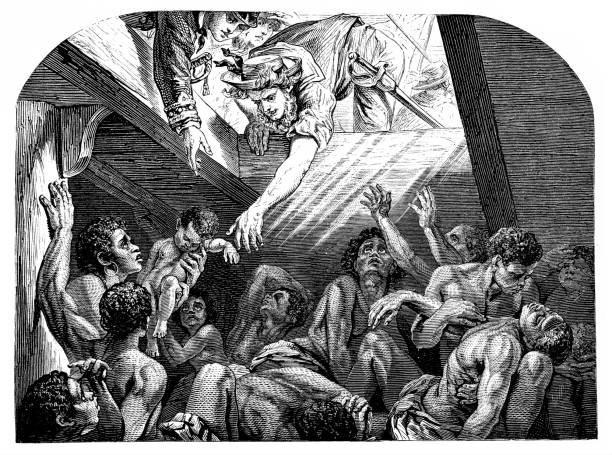
Slave ships had truly horrid conditions. Often, enslaved people suffered from disease and were viciously beat by the captains. On voyages, slaves would bravely attempt to overthrow the crew and sometimes succeed. They also would throw themselves overboard and commit suicide to prevent being subjected to the horrors of slavery.
Myth: Farming Crops Like Sugar And Cotton Was Safe
The dangers of plantation work is sometimes downplayed as not being life-threatening. However, slaves were exposed to disease (malaria, yellow fever, cholera) as they tended to crops and maintained farm equipment. Harvesting was hazardous, especially combined with the mills, furnaces and environmental factors.
Truth: The Life Span Of A Slave Was Incredibly Short
Enslaved people had incredibly short life spans. Around 50% of infants born to slaves died during their first year of life. Those who survived were twice as likely to die than white children through age 14. These harrowing statistics meant that the average life expectancy of a slave was just 21-22 years of age.
Myth: The North Wasn’t Complicit At All In Slavery
A common misconception about slavery is that the North wasn’t complicit in the institution at all. The truth is it promoted and profited from slavery—until even after the Civil War—with its Northern slave market. Slavery ended earlier in the North than in the South, but it wasn’t just a southern institution—its existence proliferated because of the entire nation.
Truth: White Women Played A Vital Role In Slave Trade
Even though the majority of slave traders were white men, white women were also significantly invested in it. From America to France to Britain to the Netherlands, the widows of slave-trading spouses would frequently take over for their husbands. White women were active and violent participants in slavery—and even would make Black women nurse their babies instead of their own.
Myth: The Atlantic Slave Trade Wasn’t A Global Operation
Though slavery laid America’s economic foundation, it was a horrific international operation. Slave traders in Europe sourced fabrics from South Asia to trade for enslaved Africans. Additionally, parts of non-Atlantic Africa also participated in the sadistic practice. Ships carried enslaved people from Mozambique to the Americas. Metals that slaves mined—like silver for instance—were occasionally traded to China.
Truth: The “Triangle Trade” Simplified Slave Routes
In history classes, slave routes are often referred to as the “Triangle Trade” which describes the triangular route from Europe, Africa, the Americas then back to Europe. However, there were significant alternative routes. One particular route was the biggest in the entire slave trade: Rio De Janeiro (Brazil) to Luanda (Angola) then back to Rio de Janeiro. U.S. ports like Charleston, South Carolina and Newport, Rhode Island served as starting points for voyages and brought slaves to the Americas upon their return.
Myth: Some Countries Effectively Legally Banned The Slave Trade In The 1830s
By the 1830s, all slave-trading nations in the Americas and Europe banned the traffic. However, countries like Brazil and Spain did so under political pressure and didn’t do much to enforce the bans. Slave traffickers paid notable bribes to government officials to look the other way. Most of the enslaved people who were violated by the illegal trading went to Brazil and Cuba.
Truth: White Slaveowners Engaged In Slave Cannibalism
There were unspeakable atrocities regarding what slaveowners did to their slaves. They sometimes killed captured Africans while they were being transported on ships and cooked them to feed themselves as well as other slaves on board. Slaves—and those taken in slave raids—were also killed and eaten. After Nat Turner was executed for leading one of the most violent slave revolts in history, his flesh and bones were turned into purses and trophies.
Myth: Slavery Began In 1619
By 1860, exactly two-thirds of all enslaved men, women, and children in the Western Hemisphere lived in the American South. However, slavery is part of the history for a majority of nations. This includes Greek and Roman civilization. Though historians cite 1619 as the start of slavery in America—when 20 Africans arrived to Virginia on a Dutch ship—the slave trade lasted from 1440-1888.
Truth: Black Folks Came To America Long Before Slavery
Some believe that slavery was the first time Africans arrived in America. However, Africans first came to this country in the late 16th century but not as slaves: they were explorers alongside Spanish and Portuguese explorers.
Myth: Every Southerner Owned Slaves
A pervasive myth is that all Southerners were slaveowners. In reality, around 25 percent of all Southerners owned slaves. However, the antebellum South was built on the institution of slavery. Many white families couldn’t afford slaves but wanted to as a symbol of wealth. Additionally, a number of Confederates who may not have owned slaves went to war to protect the inhumane practice of it. Slaveowners would also force slaves to have sex with each other.
Truth: Slaves Were Raped To Produce More Slaves
Slaveowners sexually assaulted and abused their women slaves—and demanded reproduction from them. Rape was used as a tool to both force the women into submission and increase the profit of slaveholders through breeding. The slaves did their best to resist and rebel against such violence, while white women failed to oppose the gruesome behavior perpetrated by their husbands.
Myth: House Slaves Had Better Lives Than Field Slaves
While field slaves were subjected to the brutal physical labor of clearing land, planting and harvesting, house slaves experienced emotional and physical violence at the hands of their masters. The rape of Black women was so pronounced that 16.7 percent of African Americans’ ancestors can be traced back to Europe. They were also mistreated by the wives of slaveowners, who would slap their faces, box their ears, and flog them.
Truth: Slaves Were Legally Turned Into Objects
There is a misconception that slavery in the Americas was the same as slavery in different eras and regions. However, the biggest difference is that during American slavery Africans were legally turned into objects/property so they didn’t have any human rights. During other iterations of it, slaves maintained some type of humanity under the law.
Myth: The Underground Railroad Was An Actual Railroad
The Underground Railroad wasn’t a railroad, but a network of people—both Black and white—that provided shelter and help to Southern slaves that escaped. “Conductors” guided the fugitive slaves and hid them in private homes, churches and schoolhouses. These locations were labeled “depots,” “stations” and “safe houses.” Routes extended west through Ohio to Indiana and Iowa. Some went north through Pennsylvania and into New England or through Detroit with Canada as their final destination.
Truth: Slaves Fought In Attempts To Secure Freedom
One of the most disturbing—and downright false—assertions about slavery is that slaves were complaint and docile to their masters. In reality, they participated in numerous revolts and those are just the ones that have been historically documented. Some of the most infamous include the Stono Rebellion in 1739, the German Coast Uprising in 1811 and Nat Turner’s Rebellion in 1831.
Myth: The Emancipation Proclamation Ended Slavery
In 1863—at the height of the Civil War—President Abraham Lincoln issued the final Emancipation Proclamation which officially freed all slaves not living in specified Union-controlled areas of the Confederacy. It also allowed Black people to enroll into the military. However, this left around one million people still enslaved. In 1865, the 13th Amendment became a part of the U.S. Constitution which officially abolished slavery—and laid the groundwork for mass incarceration.
Truth: During Reconstruction And Jim Crow Dangerous Black Stereotypes Emerged
During the period before and after the Civil War, dangerous stereotypes about Black people emerged to maintain white supremacist superiority. They included the mammy, the coon, the Sambo and the Tom and permeated everything from food products (Aunt Jemima and Uncle Ben) to movies to home items like salt-and-pepper shakers and lawn ornaments. Movies like D.W. Griffith’s Birth of a Nation portrayed Black men as rapists who preyed on white women, allowing the Ku Klux Klan and lynch mobs to be born.
Myth: Slavery Does Not Exist Today
Slavery has taken the modern form of mass incarceration. In fact, the United States has the highest prison population in the world. Around 2.2 million Americans are currently incarcerated with 4.5 million on probation or parole. What’s even more disturbing is that even though Black people make up 13 percent of the general population, they make up 34 percent of the 6.8 million people in the justice system. That labor is used to produce goods and services for businesses that benefit from prison labor.
Source: The Root

The Transatlantic Slave Trade lasted for more than 400 years.
By Candace McDuffie, The Root —
The legacy of slavery still has modern-day repercussions for Black Americans. It lasted four centuries and was the worst crime against humanity this country has ever committed. America’s economy thrived off of this cruel practice for an extensive period of time by kidnapping millions of Africans. Here are 21 truths and myths about the transatlantic slave trade.
Myth: Africans Were Unskilled Laborers
Slave labor has often been portrayed as unskilled work, in an attempt to justify the brutal torture and dehumanization that Africans were subjected to. In reality, cultivating sugar, cotton, tobacco and other crops required meticulous and strenuous efforts. Slaves were highly skilled tailors, carpenters, blacksmiths, masons, cooks and more.
Truth: Africans Jumped Overboard To Avoid Slavery
Slave ships had truly horrid conditions. Often, enslaved people suffered from disease and were viciously beat by the captains. On voyages, slaves would bravely attempt to overthrow the crew and sometimes succeed. They also would throw themselves overboard and commit suicide to prevent being subjected to the horrors of slavery.
Myth: Farming Crops Like Sugar And Cotton Was Safe
The dangers of plantation work is sometimes downplayed as not being life-threatening. However, slaves were exposed to disease (malaria, yellow fever, cholera) as they tended to crops and maintained farm equipment. Harvesting was hazardous, especially combined with the mills, furnaces and environmental factors.
Truth: The Life Span Of A Slave Was Incredibly Short
Enslaved people had incredibly short life spans. Around 50% of infants born to slaves died during their first year of life. Those who survived were twice as likely to die than white children through age 14. These harrowing statistics meant that the average life expectancy of a slave was just 21-22 years of age.
Myth: The North Wasn’t Complicit At All In Slavery
A common misconception about slavery is that the North wasn’t complicit in the institution at all. The truth is it promoted and profited from slavery—until even after the Civil War—with its Northern slave market. Slavery ended earlier in the North than in the South, but it wasn’t just a southern institution—its existence proliferated because of the entire nation.
Truth: White Women Played A Vital Role In Slave Trade
Even though the majority of slave traders were white men, white women were also significantly invested in it. From America to France to Britain to the Netherlands, the widows of slave-trading spouses would frequently take over for their husbands. White women were active and violent participants in slavery—and even would make Black women nurse their babies instead of their own.
Myth: The Atlantic Slave Trade Wasn’t A Global Operation
Though slavery laid America’s economic foundation, it was a horrific international operation. Slave traders in Europe sourced fabrics from South Asia to trade for enslaved Africans. Additionally, parts of non-Atlantic Africa also participated in the sadistic practice. Ships carried enslaved people from Mozambique to the Americas. Metals that slaves mined—like silver for instance—were occasionally traded to China.
Truth: The “Triangle Trade” Simplified Slave Routes
In history classes, slave routes are often referred to as the “Triangle Trade” which describes the triangular route from Europe, Africa, the Americas then back to Europe. However, there were significant alternative routes. One particular route was the biggest in the entire slave trade: Rio De Janeiro (Brazil) to Luanda (Angola) then back to Rio de Janeiro. U.S. ports like Charleston, South Carolina and Newport, Rhode Island served as starting points for voyages and brought slaves to the Americas upon their return.
Myth: Some Countries Effectively Legally Banned The Slave Trade In The 1830s
By the 1830s, all slave-trading nations in the Americas and Europe banned the traffic. However, countries like Brazil and Spain did so under political pressure and didn’t do much to enforce the bans. Slave traffickers paid notable bribes to government officials to look the other way. Most of the enslaved people who were violated by the illegal trading went to Brazil and Cuba.
Truth: White Slaveowners Engaged In Slave Cannibalism
There were unspeakable atrocities regarding what slaveowners did to their slaves. They sometimes killed captured Africans while they were being transported on ships and cooked them to feed themselves as well as other slaves on board. Slaves—and those taken in slave raids—were also killed and eaten. After Nat Turner was executed for leading one of the most violent slave revolts in history, his flesh and bones were turned into purses and trophies.
Myth: Slavery Began In 1619
By 1860, exactly two-thirds of all enslaved men, women, and children in the Western Hemisphere lived in the American South. However, slavery is part of the history for a majority of nations. This includes Greek and Roman civilization. Though historians cite 1619 as the start of slavery in America—when 20 Africans arrived to Virginia on a Dutch ship—the slave trade lasted from 1440-1888.
Truth: Black Folks Came To America Long Before Slavery
Some believe that slavery was the first time Africans arrived in America. However, Africans first came to this country in the late 16th century but not as slaves: they were explorers alongside Spanish and Portuguese explorers.
Myth: Every Southerner Owned Slaves
A pervasive myth is that all Southerners were slaveowners. In reality, around 25 percent of all Southerners owned slaves. However, the antebellum South was built on the institution of slavery. Many white families couldn’t afford slaves but wanted to as a symbol of wealth. Additionally, a number of Confederates who may not have owned slaves went to war to protect the inhumane practice of it. Slaveowners would also force slaves to have sex with each other.
Truth: Slaves Were Raped To Produce More Slaves
Slaveowners sexually assaulted and abused their women slaves—and demanded reproduction from them. Rape was used as a tool to both force the women into submission and increase the profit of slaveholders through breeding. The slaves did their best to resist and rebel against such violence, while white women failed to oppose the gruesome behavior perpetrated by their husbands.
Myth: House Slaves Had Better Lives Than Field Slaves
While field slaves were subjected to the brutal physical labor of clearing land, planting and harvesting, house slaves experienced emotional and physical violence at the hands of their masters. The rape of Black women was so pronounced that 16.7 percent of African Americans’ ancestors can be traced back to Europe. They were also mistreated by the wives of slaveowners, who would slap their faces, box their ears, and flog them.
Truth: Slaves Were Legally Turned Into Objects
There is a misconception that slavery in the Americas was the same as slavery in different eras and regions. However, the biggest difference is that during American slavery Africans were legally turned into objects/property so they didn’t have any human rights. During other iterations of it, slaves maintained some type of humanity under the law.
Myth: The Underground Railroad Was An Actual Railroad
The Underground Railroad wasn’t a railroad, but a network of people—both Black and white—that provided shelter and help to Southern slaves that escaped. “Conductors” guided the fugitive slaves and hid them in private homes, churches and schoolhouses. These locations were labeled “depots,” “stations” and “safe houses.” Routes extended west through Ohio to Indiana and Iowa. Some went north through Pennsylvania and into New England or through Detroit with Canada as their final destination.
Truth: Slaves Fought In Attempts To Secure Freedom
One of the most disturbing—and downright false—assertions about slavery is that slaves were complaint and docile to their masters. In reality, they participated in numerous revolts and those are just the ones that have been historically documented. Some of the most infamous include the Stono Rebellion in 1739, the German Coast Uprising in 1811 and Nat Turner’s Rebellion in 1831.
Myth: The Emancipation Proclamation Ended Slavery
In 1863—at the height of the Civil War—President Abraham Lincoln issued the final Emancipation Proclamation which officially freed all slaves not living in specified Union-controlled areas of the Confederacy. It also allowed Black people to enroll into the military. However, this left around one million people still enslaved. In 1865, the 13th Amendment became a part of the U.S. Constitution which officially abolished slavery—and laid the groundwork for mass incarceration.
Truth: During Reconstruction And Jim Crow Dangerous Black Stereotypes Emerged
During the period before and after the Civil War, dangerous stereotypes about Black people emerged to maintain white supremacist superiority. They included the mammy, the coon, the Sambo and the Tom and permeated everything from food products (Aunt Jemima and Uncle Ben) to movies to home items like salt-and-pepper shakers and lawn ornaments. Movies like D.W. Griffith’s Birth of a Nation portrayed Black men as rapists who preyed on white women, allowing the Ku Klux Klan and lynch mobs to be born.
Myth: Slavery Does Not Exist Today
Slavery has taken the modern form of mass incarceration. In fact, the United States has the highest prison population in the world. Around 2.2 million Americans are currently incarcerated with 4.5 million on probation or parole. What’s even more disturbing is that even though Black people make up 13 percent of the general population, they make up 34 percent of the 6.8 million people in the justice system. That labor is used to produce goods and services for businesses that benefit from prison labor.
Source: The Root
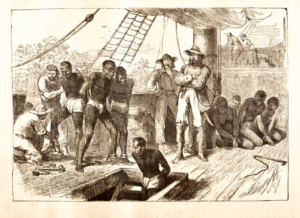
Steel engraving from 1881 with great details
-
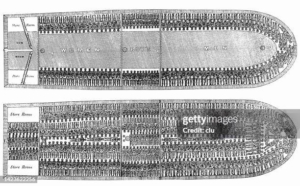
Brooks (or Brook, Brookes, or Bruz) was a British slave ship launched at Liverpool in 1781. Illustration from 19th century.
Previous Post‘Highway to horror’: 14 wrecked slavers’ ships are identified in Bahamas